Pet Ownership Statistics Ireland 2026: Dogs, Cats, Costs and Rentals
Last updated: October 2026. Human compiled and fact checked against each named source.
Ireland keeps more than 560,000 dogs and 400,000 cats, a third of adults own a dog, and the average household now spends almost €460 a year on pets. Behind those headline numbers sit a licensing system that covers a fraction of the dogs, a pound system that took in more than 7,000 dogs last year, and a rental market where only 7% of listings allow pets. This page gathers the key Irish pet ownership figures in one place: how many pets there are, what they cost, what happens to the dogs that lose their homes, and what pet ownership means for the homes they live in. Every figure links to its primary source, and anything we derived is labelled as calculated.
Key Pet Ownership Statistics for Ireland at a Glance
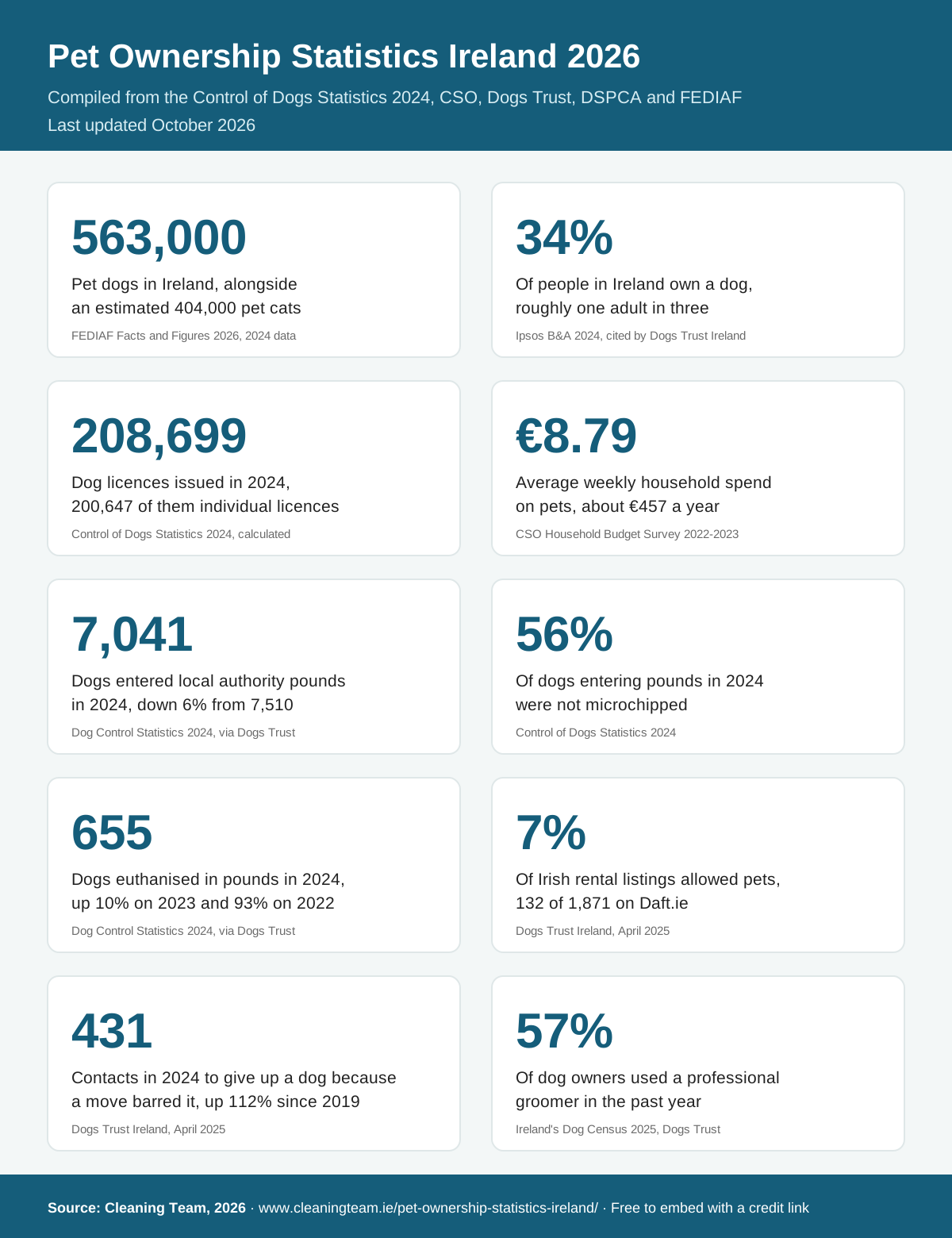
- Ireland has an estimated 563,000 pet dogs and 404,000 pet cats, the 2024 figures compiled by the European pet food federation. Source: FEDIAF Facts and Figures 2026
- 34% of people in Ireland own a dog, according to a 2024 Ipsos B&A study cited by Dogs Trust. Source: Dogs Trust Ireland, April 2025
- 208,699 dog licences were issued in 2024, made up of 200,647 individual, 7,752 lifetime and 300 general licences, calculated from the official breakdown. Source: Control of Dogs Statistics Report 2024
- The average Irish household spends €8.79 a week on pets, about €457 a year, calculated from the Household Budget Survey. Source: CSO Household Budget Survey 2022-2023, table HBS01
- Rural households spend €10.55 a week on pets against €7.78 in urban areas, 36% more, calculated from the same table. Source: CSO HBS table HBS01
- 7,041 stray, surrendered or seized dogs entered local authority pounds in 2024, down 6% from 7,510 in 2023. Source: Dog Control Statistics 2024, reported by Dogs Trust Ireland
- 56% of dogs entering pounds in 2024 were not microchipped, even though microchipping has been compulsory for dogs born since 2016. Source: Control of Dogs Statistics Report 2024
- 655 dogs were euthanised in Irish pounds in 2024, up 10% on 2023 and 93% on 2022. Source: Dog Control Statistics 2024, reported by Dogs Trust Ireland
- Only 7% of rental listings in Ireland, 132 out of 1,871 on Daft.ie, allowed pets when Dogs Trust checked in 2025. Source: Dogs Trust Ireland, April 2025
- 57% of dog owners used a professional groomer in the past year, the most used dog service in Ireland. Source: Ireland's Dog Census 2025
How Many Pets Are There in Ireland
Ireland has no official pet census, so the national population figures come from the European pet food federation, FEDIAF, which compiles estimates from its national associations each year. Its 2026 report, covering 2024 data, puts Ireland at 563,000 dogs and 404,000 cats, together about 967,000 animals, calculated from the two figures. Across Europe the same report counts 91.2 million dogs and 110.9 million cats, so Ireland is unusual in keeping more dogs than cats; most European countries run the other way. The ownership rate backs that up. A 2024 Ipsos B&A study, cited by Dogs Trust, found that 34% of people in Ireland own a dog, roughly one adult in three.
Most dog-owning homes keep one animal. Ireland's Dog Census 2025, which gathered responses from 22,366 dog owners covering 26,289 dogs and weighted them to a nationally representative Ipsos B&A survey, found 74% of owners have a single dog, 18% have two and 7% have three or more. The Jack Russell is the most common breed for the second year running, ahead of mixed breeds and the Border Collie, with the Labrador Retriever and Cocker Spaniel completing the top five. Luna, Bailey and Bella are the three most popular names. Breeders and rescues supply dogs in equal measure, at 27% each, while 13% of dogs came from a friend or family member and 8% from an online marketplace or classified ad. Worryingly, 31% of owners did no research at all before getting their dog, and 18% said their dog had serious health issues in its first year.
Dog Licences and Microchipping
Every dog in Ireland is supposed to carry a licence, and 2024 was the first year in four that individual licences passed 200,000. The Control of Dogs Statistics Report 2024, published in November 2025, records 200,647 individual licences, 7,752 lifetime licences and 300 general licences, up from 195,821 individual and 7,247 lifetime licences in the 2023 report. Set against the 563,000 dogs FEDIAF estimates, the 208,699 licences issued in 2024 cover about 37% of the dog population, a calculated figure that understates true coverage because lifetime licences bought in earlier years are not counted again. Cork County issues more licences than any other local authority, and the report expects online sales to overtake counter sales at post offices in 2026.
Microchipping has been a legal requirement for every dog born after 31 March 2016, yet the pound data suggests compliance is poor among the dogs most likely to go astray. Of the dogs entering local authority pounds in 2024, 34% were microchipped and registered, a further 3% were chipped but never registered on an approved database, and 56% were not chipped at all. Neutering rates were lower still: only 4% of dogs entering pounds were confirmed neutered, 51% were not, and the rest were unknown. All pounds now scan for a chip before releasing a dog, but just 16% neuter dogs as standard before rehoming, down from 20% in 2023.
What Irish Households Spend on Pets
The CSO's Household Budget Survey is the only official measure of pet spending in Ireland. In its 2022-2023 round, the average household spent €8.79 a week on pet costs out of total weekly expenditure of €1,007.47, which works out at 0.87% of the household budget and roughly €457 a year, both calculated from the table. Because the average includes the majority of households that keep no pet at all, the spend per pet-owning household is considerably higher. The pattern across household types is consistent: pets are a rural, owner-occupier and higher-income habit.
| Household group | Weekly pet costs | Source table |
|---|---|---|
| All households | €8.79 | HBS01 |
| Urban | €7.78 | HBS01 |
| Rural | €10.55 | HBS01 |
| Owned outright | €10.18 | HBS02 |
| Owned with mortgage | €10.37 | HBS02 |
| Rented, including rent free | €5.66 | HBS02 |
| Lowest income fifth | €6.89 | HBS03 |
| Highest income fifth | €13.48 | HBS03 |
| One-person household | €4.52 | HBS04 |
| Two-person household | €10.45 | HBS04 |
| Eastern and Midland region | €9.71 | HBS06 |
| Northern and Western region | €6.84 | HBS06 |
Three gaps stand out. Households that own their home spend around 80% more on pets each week than renters, calculated from the €10.18 and €5.66 figures, which mirrors how hard it is to rent with a pet. The highest-earning fifth of households spend almost twice what the lowest fifth spend, calculated from the quintile table. And the one-person household figure of €4.52 is less than half the two-person figure, because pets are far more common in family homes. Owners feel the cost too: in the Dog Census 2025, 36% of dog owners said vet bills were a financial struggle, followed by insurance at 14%, grooming at 13%, boarding at 12% and food at 10%. Even so, 78% of owners had their dog's vaccinations up to date within the past year.
Pounds, Surrenders and Rehoming
Local authority pounds are the backstop of Ireland's dog population, and the Department of Rural and Community Development's 2024 return shows a system under less pressure on entries but worse pressure on outcomes. 7,041 dogs entered pounds in 2024, 469 fewer than the 7,510 of 2023, yet the number euthanised rose from 596 to 655, a 10% increase that follows a 75% jump the year before. Where the basis of entry was recorded, 3,610 dogs arrived as strays, 1,051 were surrendered by their owners and 161 were seized. 55% of entrants were male, most were five years old or younger, and the most common types were non-restricted crossbreeds, terrier types, collies, lurchers and Jack Russells. Of the dogs leaving pounds, 42% went to welfare charities, 30% were rehomed directly by the pound, 19% were reclaimed by their owners and 9% were put to sleep.
The report also tracks why owners give dogs up. When pounds logged surrender enquiries, 53% ended with the dog being handed over and 42% with advice given instead, and the two most quoted owner-related reasons were the owner's health and a change in accommodation. The charities see the same picture at a larger scale. Dogs Trust Ireland received 3,968 surrender requests in 2023, the most since it opened in 2009, and rehomed 1,042 dogs that year. In 2025 adolescent dogs aged six months to two years accounted for 885 requests, 42% of all surrender requests, which implies roughly 2,100 requests across the year, calculated from those two figures. Among census respondents who had given up a dog, 39% cited a change in living situation, 18% unwanted behaviour and 10% time constraints. In Dublin, the DSPCA rehomed 1,909 animals in 2024, up from 1,758 in 2023, including 900 cats, 750 dogs and 250 small animals, and answered 2,544 inspector and ambulance callouts, almost double the previous year.
Pets and Rented Homes
Housing is now the single biggest reason Irish dogs lose their homes. When Dogs Trust checked the country's largest rental platform in 2025, only 132 of 1,871 listings on Daft.ie, 7%, allowed pets. The charity logged 431 calls or emails in 2024 from people needing to give up a dog because a move did not allow it, up from 203 in 2019, an increase of 112% in five years. Among census respondents forced to give up a dog by a change in living situation, 31% said their new landlord did not allow dogs, 12% had moved to a smaller home, 8% had lost a garden and 6% were blocked by a management company. Among people who would like a dog but do not have one, housing and rental restrictions tie with work circumstances as the biggest barrier, at 31% each, and 69% say they will get a dog when their situation allows.
Public opinion is clearly on the tenants' side: 81% of the more than 24,000 people surveyed through the 2024 Dog Census believe dog owners should have the right to keep a pet in rented accommodation, and more than 20,000 people signed the Dogs Trust petition against blanket bans in 2025. In November 2025 the government's Housing Action Plan 2025-2030 committed to ending blanket pet bans in tenancy agreements, starting with approved housing body properties, though private tenancies are not yet covered. For the tenants who do keep a pet, the deposit is the practical worry. Our rental deposit statistics for Ireland page sets out how often deposits are withheld and why, and pet hair, odours and scratched floors feature in exactly the kind of cleaning disputes that an end of tenancy clean is meant to prevent.
Dog Control, Attacks and Enforcement
The 2024 report is the first full year of data since the XL Bully ban took effect on 1 October 2024, and it shows 1,194 incidents of aggressive dog behaviour reported to local authorities, down from 1,383 in 2023, with 405 people physically injured, down from 442. Where the breed was known, German Shepherds were involved in 16% of incidents and restricted breeds in 48%. Livestock worrying moved the other way, with reported incidents up 4% on 2023 and sheep the main victims. Enforcement remains thin: dog wardens issued 1,763 fixed charge notices in 2024, of which only 600, or 34%, were paid, and every local authority dog control unit that filed accounts reported an operating deficit. The country's dog control service ran on 55 full-time and 18 part-time wardens, 63.5 full-time equivalents, and 33 pounds or shelters, which is why the government has put €2 million towards up to 40 additional wardens from 2025 on top of €6 million in capital funding across 2023 and 2024.
Dog owners themselves rank other owners as the biggest problem. In the Dog Census 2025, 31% named owners not taking responsibility in public places as their top issue, and 28% named the lack of dog-friendly spaces. Asked what irresponsible ownership looks like, 88% said not picking up dog waste, 79% poor control in public and 72% letting dogs off the lead in restricted areas. Training is widespread but imperfect: 82% of dogs have had some training, 64% of it by the owner, yet 36% of owners say their dog does not always come back when called and 33% say it struggles to settle when visitors arrive.
Pet fur and dander are among the home triggers the Asthma Society names, and 15.8% of Irish adults report an allergy, per our allergy and asthma statistics for Ireland, so a pet-owning home is often also an allergy-managing one.
What It Means for the Home
Nearly a million dogs and cats live inside Irish homes, and the Dog Census shows how much of their care happens there. 57% of dog owners used a professional groomer in the past year, 22% used boarding kennels, 15% home boarding and 9% a daycare centre, which leaves most of the week's hair, mud and dander for the household to deal with. The products used to clean up after pets matter too. Our cleaning product safety statistics page records how often the National Poisons Information Centre is called about household chemicals, a reminder to store cleaning products away from inquisitive animals as carefully as from children. The first page in this series, our cleaning statistics for Ireland, covers how much time Irish households already spend on housework before a pet is added to the load.
In practical terms, a dog-owning home collects hair in carpets and upholstery faster than a vacuum removes it, and a cat's litter area needs the same disinfecting routine as a bathroom. Rented homes with pets face the extra test of inspection day, when the 7% of landlords who allow pets expect the property back without a trace of them. Our guides to deep cleaning and end of tenancy cleaning describe what that involves room by room.
Method and Sources
Every statistic on this page was verified against its named source on 27 October 2026. The sources are the Local Authority Control of Dogs Statistics Report 2024, published by the Department of Rural and Community Development and the Gaeltacht on behalf of the Department of Agriculture, Food and the Marine in November 2025, together with the 2023 report for comparisons; the Dogs Trust Ireland statement of 14 November 2025, which quotes the national pound totals from the appendix of that report; Ireland's Dog Census 2025 by Dogs Trust Ireland, weighted by Ipsos B&A; the Dogs Trust statements of February 2024 and April 2025; the DSPCA Impact Report 2024; the FEDIAF Facts and Figures 2026 report for pet population estimates based on 2024 data; and the CSO Household Budget Survey 2022-2023, tables HBS01 to HBS07, queried directly from the CSO PxStat API. Calculated figures are labelled in the text: the total licences issued, the licence coverage rate, the combined dog and cat population, the annual and percentage pet spend, the rural, tenure, income and household size gaps, and the implied 2025 surrender request total. The dog control statistics are published each autumn for the previous year, the Household Budget Survey roughly every five years, the Dog Census each spring and the FEDIAF report each summer; this page will be refreshed when the 2025 dog control report and the 2026 Dog Census publish.
How Cleaning Team Helps
Cleaning Team cleans pet-owning homes across Dublin, Kildare, Meath and Wicklow every day, from regular house cleaning that keeps hair and dander under control to one-off deep cleaning of carpets, upholstery and floors, and end of tenancy cleaning for tenants who need a pet-friendly rental handed back spotless. If your home has a dog, a cat or both, contact us for a quote or book online in a few minutes.