Allergy and Asthma Statistics Ireland 2026: Hay Fever, Eczema and the Home
Last updated: November 2026. Human compiled and fact checked against each named source.
Almost one Irish adult in six reports an allergy, close to one in eleven has asthma, and Ireland's asthma death rate runs well above the EU average. The newest figures come from the CSO's Irish Health Survey 2025, published in May 2026, and they sit alongside Eurostat data on deaths and hospital stays, the Asthma Society's cost and hay fever research, and the Irish Skin Foundation's work on eczema. This page gathers the key Irish allergy and asthma figures in one place: how many people are affected, who they are, what it costs, how Ireland compares with Europe, and what the household triggers mean for the home. Every figure links to its primary source, and anything we derived is labelled as calculated.
Key Allergy and Asthma Statistics for Ireland at a Glance
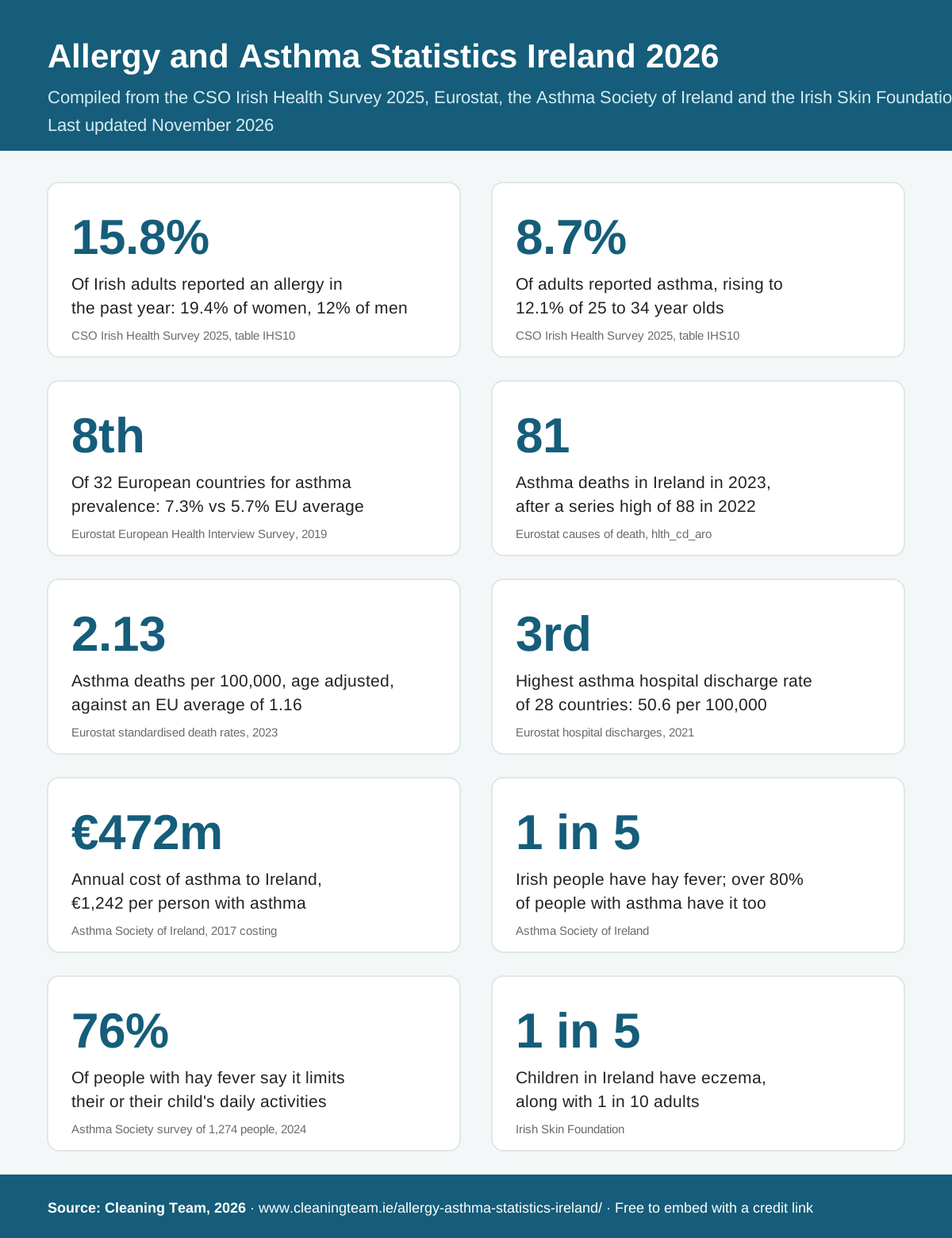
- 15.8% of adults in Ireland reported an allergy such as hay fever, dermatitis or food allergy in the past year, 19.4% of women and 12% of men. Source: CSO Irish Health Survey 2025, table IHS10
- 8.7% of adults reported asthma in the past year, rising to 12.1% of 25 to 34 year olds. Source: CSO Irish Health Survey 2025, table IHS10
- Ireland's asthma prevalence of 7.3% was the eighth highest of 32 European countries in the last harmonised EU health survey, against an EU average of 5.7%. Source: Eurostat EHIS, 2019
- 81 people died from asthma in Ireland in 2023, and 88 in 2022, the highest annual total in the Eurostat series. Source: Eurostat causes of death
- Ireland's age-standardised asthma death rate was 2.13 per 100,000 in 2023 against an EU average of 1.16, 84% higher, calculated from the two rates. Source: Eurostat standardised death rates
- Irish hospitals discharged 50.6 asthma patients per 100,000 people in 2021, the third highest rate of 28 reporting European countries. Source: Eurostat hospital discharges
- Asthma cost Ireland €472 million in 2017, or €1,242 per person with asthma, including 133,000 emergency department visits. Source: Asthma Society of Ireland, Easing the Economic Burden of Asthma, 2019
- One in five Irish people has hay fever, and more than 80% of people with asthma have it too. Source: Asthma Society of Ireland
- 76% of people with hay fever say it limits their or their child's daily activities, and 42% missed at least a day of work or education in a year because of it. Source: Asthma Society survey of 1,274 people, March 2024
- Eczema affects around one in five children and one in ten adults in Ireland. Source: Irish Skin Foundation
How Many People in Ireland Have Allergies
The CSO's Irish Health Survey is the only national measure of allergy in Ireland, and its 2025 round asked adults which long-standing conditions they had experienced in the previous twelve months. 15.8% of people aged 15 and over reported an allergy such as rhinitis, hay fever, eye inflammation, dermatitis or food allergy, with allergic asthma counted separately. That is roughly one adult in six, calculated from the rate. Women are far more likely to report an allergy than men, 19.4% against 12%, and the gap holds at every age. Allergy also skews young: 19.4% of 25 to 34 year olds and 18.2% of 15 to 24 year olds reported one, against 11.5% of 65 to 74 year olds and 9% of people aged 75 and over. Among women aged 25 to 34, the rate reaches 23.7%, almost one in four.
There is a regional pattern too. The Dublin and South East health region reported the highest allergy rate at 18.6%, followed by Dublin and Midlands at 16.8% and Dublin and North East at 16.1%, while the Midwest at 12.4% and the West and North West at 12.7% reported the lowest, all from the same CSO table. For comparison, the first Irish Health Survey in 2015 put allergies at 14%, so the share has edged up over a decade. The EU-wide picture is noisier: the last harmonised European Health Interview Survey in 2019 recorded an EU average allergy rate of 18.5%, led by Finland at 34.2% and Germany at 31%, though the 2019 Irish return of 7.8% is well below both the 2015 and 2025 CSO figures and should be read as a survey-method difference rather than a real dip.
Asthma in Ireland by Age, Sex and Region
Asthma is Ireland's most common chronic respiratory condition and one of the most common chronic conditions of any kind. In the 2025 survey, 8.7% of adults reported asthma in the past year, 9.5% of women and 7.9% of men. Unlike most chronic conditions, asthma is most prevalent among the young: 11.9% of 15 to 24 year olds and 12.1% of 25 to 34 year olds reported it, falling to 6.7% of 45 to 54 year olds and 6% of people aged 75 and over. Among women aged 25 to 34 the rate was 14.4%, the highest of any group in the table. Regionally the spread is narrower than for allergy, from 9.6% in Dublin and North East to 7.3% in the Midwest. The Healthy Ireland Survey, which counts only conditions confirmed by a medical diagnosis, puts diagnosed asthma at 5% of people aged 15 and over, level with diabetes and behind only high blood pressure and arthritis, and finds it twice as common among parents who are also carers, at 8% against 4% of parents generally.
The Asthma Society of Ireland's economic burden study, the most detailed Irish costing to date, estimated that 890,000 people in Ireland have had asthma at some point in their lives, including 380,000 who experience it in any given year, one in thirteen of the population. The Society's 2024 commentary uses a higher working figure of more than 450,000 people with asthma. Children carry a heavier load than adults: the CSO's children's health survey found 18.7% of children aged 3 to 14 have a long-standing illness or health problem, 20.5% of boys and 16.8% of girls, peaking at 22.7% among 9 to 12 year olds, and the Asthma Society's costing estimates that one child in ten experiences asthma in any given year.
Deaths, Hospital Stays and the EU Comparison
Asthma deaths are rare but Ireland records more of them than most of Europe. Eurostat's causes of death data count 81 asthma deaths in Ireland in 2023, after 88 in 2022, 65 in 2021 and 60 in 2020; a decade earlier, in 2013, the figure was 48. Adjusted for the age of the population, Ireland's standardised asthma death rate of 2.13 per 100,000 in 2023 compares with an EU average of 1.16, and the Irish rate has been above the EU figure in every year of the series since 2011. The Asthma Society holds that 90% of asthma deaths are preventable, a position set out in its pre-budget submission.
| Measure | Ireland | EU or European comparison | Source |
|---|---|---|---|
| Adults reporting asthma, 2019 harmonised survey | 7.3% | EU average 5.7%, Ireland 8th of 32 | Eurostat EHIS |
| Asthma deaths per 100,000, age-standardised, 2023 | 2.13 | EU average 1.16 | Eurostat |
| Asthma deaths, number, 2023 | 81 | 88 in 2022, 48 in 2013 | Eurostat |
| Asthma hospital discharges per 100,000, 2021 | 50.6 | 3rd highest of 28 countries; Italy 4.3, Sweden 19.1, Germany 41.6 | Eurostat |
| Asthma hospital discharges per 100,000, 2019 | 82.5 | 6th highest of 29 countries | Eurostat |
Hospital use tells the same story. Irish hospitals recorded 82.5 asthma discharges per 100,000 people in 2019, the sixth highest rate of 29 reporting countries, and 50.6 per 100,000 in 2021, the third highest of 28 behind only Bulgaria and France. The 2021 figure is lower across Europe because of the pandemic, but Ireland's rate was still more than ten times Italy's 4.3 and well over double Sweden's 19.1. Back in 2000 Ireland's rate was 126.6 per 100,000, so the long-run trend is downward even if the European ranking has not moved.
What Asthma Costs Ireland
The Asthma Society of Ireland commissioned a full economic costing in 2019, and its figures remain the reference numbers. Asthma cost Ireland €472 million in 2017, equal to €1,242 per person with asthma. Direct healthcare costs accounted for 57% of the total, €270 million, including an estimated 133,000 emergency department visits, almost 8,000 hospital stays, 2.4 million GP consultations and 625,000 practice nurse consultations in the year, and medication alone cost €45 million. The indirect side was dominated by lost work: 1.4 million workdays were lost to asthma in 2017. The report estimated that a universal self-management programme could save the State between €68 million and €102 million a year, a case the Society has put in every pre-budget submission since.
Hay Fever, Eczema and Food Allergy
Hay fever, or allergic rhinitis, is the most common allergy in Ireland. The Asthma Society puts it at one in five Irish people, notes that more than 80% of people with asthma also have hay fever, and cites research that 10% to 40% of hay fever patients go on to develop asthma. The condition is triggered by pollen outdoors but also by house dust mites and pet fur indoors, which is why symptoms persist through winter for many people. When the Society surveyed 1,274 people with asthma or hay fever in March 2024, 76% of the 727 with hay fever said it limited their or their child's daily activities, 42% had missed at least one day of work or education in the past year because of it, one in five had missed more than three days, and 75% felt policymakers did not take hay fever seriously.
Eczema is the skin side of the same allergic tendency. The Irish Skin Foundation estimates that it affects around one in five children and one in ten adults in Ireland, while noting that accurate Irish skin disease statistics are scarce. Its survey of 454 people living with mostly moderate to severe eczema, run between September 2018 and April 2019, found that 86% of children and 84% of adults had ongoing sleep disturbance, that 42% of carers of children and 49% of adults had cut back on household expenses to pay for managing the condition, and that a quarter of respondents spent at least €2,300 a year on doctor's fees, over-the-counter products and prescriptions. Food allergy is rarer. The Food Safety Authority of Ireland's scientific committee cites an Irish study of 1,355 children up to two years old in which 4.5% had a food allergy, most often to egg at 3%, peanut at 1.8% and cow's milk at 0.7%, and estimates that prevalence among older children and adults is likely to be around 1% to 2%, in line with the UK.
What It Means for the Home
The Asthma Society lists the home triggers that matter most for people with asthma as pets, dust and dust mites, mould, smoke and cleaning products, and the Irish figures on each of those are not encouraging. 21.2% of people in Ireland live with a leaking roof, damp walls or rot against an EU average of 15.6%, the figures set out on our mould and damp statistics page, and damp is the precondition for both mould and dust mites. A third of Irish adults own a dog, as our pet ownership statistics record, so pet dander is present in a large share of homes. And people spend up to 90% of winter days indoors, the season our winter illness statistics page covers, when windows stay shut and allergens concentrate.
Cleaning products themselves are on the trigger list, which is why the choice of product matters as much as the cleaning. Our cleaning product safety statistics page records how often Irish households are harmed by the chemicals they clean with, and our guide to eco-friendly cleaning in Dublin covers the low-irritant alternatives. For an allergy-prone household the practical routine is regular vacuuming with a sealed filter, hot washing of bedding, keeping humidity down and dealing with any condensation before mould takes hold, and a periodic deep clean of carpets, upholstery and mattresses where dust mites accumulate.
Method and Sources
Every statistic on this page was verified against its named source on 3 November 2026. The sources are the CSO Irish Health Survey Main Results 2025, published 20 May 2026, with table IHS10 queried directly from the CSO PxStat API for the sex, age and regional breakdowns, and table IHSC03 from the companion children's health release; Eurostat's European Health Interview Survey dataset hlth_ehis_cd1e for 2014 and 2019, its causes of death datasets hlth_cd_aro and hlth_cd_asdr2 to 2023, and its hospital discharge dataset hlth_co_disch2 to 2021, all queried from the Eurostat API; the Healthy Ireland Survey 2024 summary report; the Asthma Society of Ireland's Easing the Economic Burden of Asthma report of June 2019, its pre-budget submission 2021, its hay fever pages and its March 2024 hay fever survey release; the Irish Skin Foundation's eczema page and its 2019 survey release; and the Food Safety Authority of Ireland's 2019 scientific committee report on undeclared food allergens. Calculated figures are labelled in the text: the one-in-six allergy ratio, the 84% gap between the Irish and EU asthma death rates, and the multiples against Italy and Sweden. The CSO publishes the Irish Health Survey annually each May, Eurostat updates causes of death and hospital discharges each spring and the health interview survey roughly every five years, and the Asthma Society publishes its research around World Asthma Day in May; this page will be refreshed on the 2026 Irish Health Survey release.
How Cleaning Team Helps
Cleaning Team cleans for allergy and asthma households across Dublin, Kildare, Meath and Wicklow, from regular house cleaning that keeps dust and dander down week to week, to one-off deep cleaning of carpets, upholstery, mattresses and the damp-prone corners where mould and dust mites start. If someone in your home is among the one in six with an allergy or the one in eleven with asthma, contact us for a quote or book online in a few minutes.