Workplace Hygiene and Injury Statistics Ireland 2026: Slips, Sick Days and Lost Time
Last updated: September 2026. Human compiled and fact checked against each named source.
Workplace injuries in Ireland are counted carefully and read rarely. The figures live in a Health and Safety Authority review and a CSO survey module that most employers never open, yet they decide insurance premiums, absence budgets and cleaning contracts. This page gathers the key Irish figures on workplace injuries, hygiene and lost time in one place: how many incidents are reported, what triggers them, which sectors get hurt, what the days lost add up to, and what an employer owes a sick worker. Every figure links to its primary source, and anything we derived is labelled as calculated.
Key Workplace Injury Statistics for Ireland at a Glance
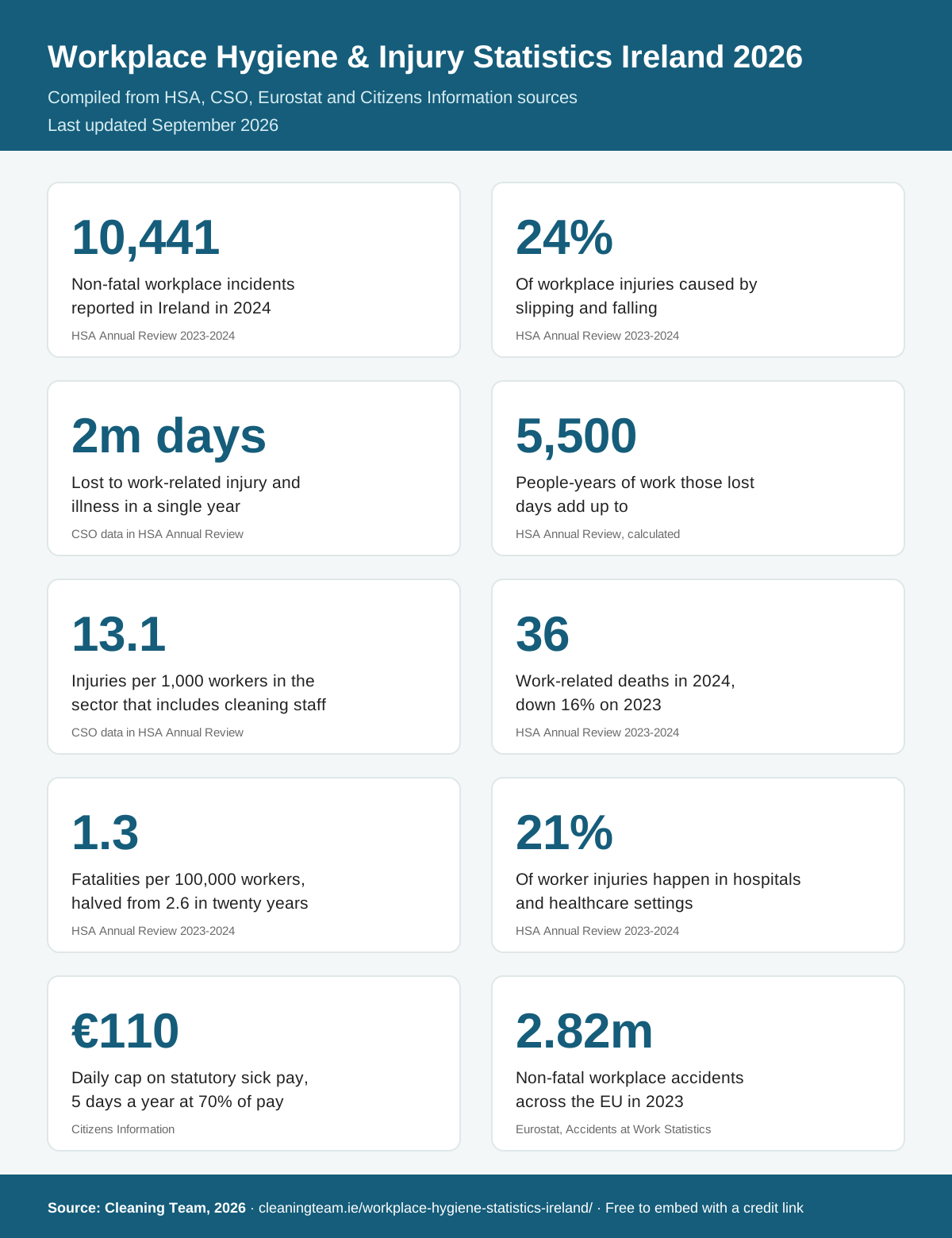
- 10,441 non-fatal workplace incidents were reported to the HSA in 2024, up 3% on 2023 and 14% above the five year average. Source: HSA Annual Review 2023-2024
- Manual handling caused 33% of those incidents and slips and falls caused 24%, the top two triggers in every major sector. Source: HSA Annual Review 2023-2024
- 688,000 working days were lost to work-related injuries and 1,330,000 to work-related illness in a single year. Source: CSO data in the HSA Annual Review
- Together that is over 2 million days, the equivalent of about 5,500 people out of work for a full year, calculated from the two CSO figures. Source: HSA Annual Review 2023-2024, calculated
- Administrative and support service activities, the sector that includes cleaning and facilities staff, has Ireland's second highest injury rate at 13.1 per 1,000 workers. Source: HSA Annual Review 2023-2024
- There were 36 work-related deaths in 2024, down 16% on 2023, and the fatality rate has halved in twenty years to 1.3 per 100,000 workers. Source: HSA Annual Review 2023-2024
- 21% of worker injuries reported in 2024 happened in hospitals and healthcare settings, and 17% in shops and service areas. Source: HSA Annual Review 2023-2024
- Female workers report work-related stress, depression or anxiety at more than double the male rate, 9.0 against 3.8 per 1,000 workers. Source: CSO data in the HSA Annual Review
- Statutory sick pay in Ireland is 5 days a year at 70% of normal pay, capped at €110 a day, paid by the employer. Source: Citizens Information
- Across the EU there were 2.82 million non-fatal workplace accidents in 2023, a rate of 1,393 per 100,000 workers. Source: Eurostat, Accidents at Work Statistics
Ireland's Workplace Injury Numbers
There were 10,441 non-fatal workplace incidents reported to the Health and Safety Authority in 2024, an increase of 3% on the 10,113 reported in 2023 and 14% above the five year average, according to the HSA Annual Review of Workplace Injuries, Illnesses and Fatalities 2023-2024. The single most common trigger was manual handling, which accounted for 3,474 incidents or 33%, with slipping and falling second at 2,815 incidents or 24%, and the review notes that these two were among the top two triggers in every major economic sector. Employees made up 9,839 of the injured, 94% of the total, with the remainder split between non-workers, the self employed and trainees.
The settings are familiar ones. Among worker victims, 24% of reported incidents happened in production areas, factories and workshops, 21% in hospitals and other healthcare areas, and 17% in shops and service activity areas. Health and social work activities generated 24% of all worker incidents, the most of any sector, while education accounted for 40% of injuries to non-workers, and head injuries made up 25% of all non-worker injuries.
What Lost Time Costs Irish Employers
The CSO measures the absence behind those incidents through a special module of the Labour Force Survey, reported in the same HSA review. During 2023, 688,000 working days were lost to work-related injuries, 26% above the five year average of 547,600, and 1,330,000 days were lost to work-related illness, against an average of 1,096,200. Added together that is 2,018,000 days in one year, which is the equivalent of roughly 5,500 people out of work for an entire year, calculated by dividing the combined total by 365. Illness costs nearly twice the days that injury does, calculated from the same two figures, which is why hygiene sits beside slip prevention in any serious absence strategy.
Every one of those absent days now carries a statutory price for the employer. Statutory sick pay entitles a qualifying employee to 5 days of paid sick leave a year at 70% of normal pay, capped at €110 per day, paid by the employer from the first certified day, with 13 weeks of continuous service to qualify, according to Citizens Information. The entitlement remains at 5 days in 2026. At the cap, an employer's exposure is €550 per employee per year before illness benefit takes over, calculated from the daily cap and day count.
Slips, Falls and the State of the Floor
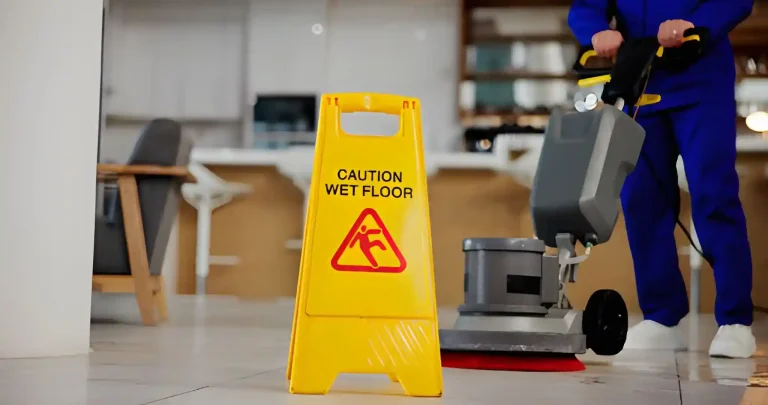
Slipping and falling caused 2,815 reported workplace injuries in 2024, 24% of the national total, second only to manual handling, per the HSA Annual Review 2023-2024. Unlike manual handling, slips are overwhelmingly an environmental problem rather than a training one: people slip on wet, greasy or contaminated floors, and rarely on clean, dry ones. That makes a quarter of Ireland's workplace injuries a housekeeping outcome, and it is why floor care standards are written into serious cleaning specifications rather than left to frequency alone. The full household side of that picture, including who does the cleaning and what it costs, is on our cleaning and housework statistics for Ireland page.
Which Sectors Get Hurt Most
The CSO module ranks sectors by injuries that caused four or more days of absence. Construction leads at 16.9 injuries per 1,000 workers, followed by administrative and support service activities at 13.1, transportation and storage at 12.7, and industry at 11.3, per the HSA Annual Review 2023-2024. The second name on that list deserves attention: administrative and support services is the NACE sector that contains cleaning and facilities staff, so the people who control everyone else's slip risk carry one of the highest injury rates themselves. It is one argument for professional crews with proper equipment over ad hoc arrangements.
| Group | Work-related injuries with 4+ days absence, per 1,000 workers (2023) |
|---|---|
| Construction | 16.9 |
| Administrative and support services (includes cleaning) | 13.1 |
| Transportation and storage | 12.7 |
| Industry | 11.3 |
| Male workers, all sectors | 10.1 |
| Female workers, all sectors | 5.5 |
The quiet end of the table is just as telling. Professional, scientific and technical activities ran at 2.5 injuries per 1,000 workers across 2019 to 2023 and information and communication at 1.6, while no Labour Force Survey respondent working in financial, insurance and real estate activities reported a four day injury at all in 2023, per the same review. The gap between a construction site at 16.9 and a desk sector at 1.6 is roughly a tenfold difference in risk, calculated from the two rates, and cleaning and facilities crews work across both ends of it.
Illness runs on a different axis to injury. The highest rates of work-related illness causing four or more days of absence were in human health and social work at 34.5 per 1,000 workers and education at 31.8. Female workers reported more work-related illness overall, 22.4 per 1,000 against 13.3 for men, with stress, depression or anxiety the starkest gap at 9.0 against 3.8. Bone, joint and muscle problems were the most common illness type for both sexes, and illness rates peak in the 55 to 64 age group at 38.4 per 1,000 workers, all per CSO data in the same review.
Fatal Accidents: the Long Decline
There were 36 fatal work-related incidents in Ireland in 2024, a 16% decrease on the 43 recorded in 2023, and the fatality rate has fallen from 2.6 per 100,000 workers in 2004 to 1.3 in 2024, halving in twenty years, according to the HSA Annual Review 2023-2024. Agriculture, forestry and fishing remains the deadliest sector with 12 deaths, a third of the total. Loss of control of vehicles or handling equipment and falls together accounted for 53% of fatal incidents, 89% of victims were male, and over half were aged 55 or older.
The detail behind the 36 deaths is worth reading closely. Seven of the victims were non-workers, people killed by work activity rather than while doing their own job, and two of the incidents involved children. Water supply, sewerage and waste management accounted for a further 17% of fatalities after agriculture, and construction lost five people. Every fatal incident category on the list involves vehicles, heights or heavy materials rather than cleaning work itself, but the wider lesson from twenty years of decline is that workplace deaths respond to systematic controls, and the same is true of the far larger count of slips and infections lower down the severity scale.
Ireland and the EU
For scale, the EU recorded 2.82 million non-fatal accidents at work in 2023, a rate of 1,393 per 100,000 employed people, and 3,298 fatal accidents, a rate of 1.63 per 100,000, according to Eurostat's Accidents at Work Statistics. Ireland's HSA-derived fatality rate of 1.3 per 100,000 workers in 2024 sits below that EU average, though the two figures come from different reporting systems and years, so the comparison is indicative rather than exact.
Hygiene as Prevention
Two of the biggest lines in the injury and illness data are directly moveable by cleaning standards: the 24% of injuries triggered by slips and falls, and the share of illness absence driven by infection in settings such as healthcare and education, the two sectors with Ireland's highest illness rates. Clean, dry floors, sanitised touch points and managed chemical storage are not cosmetic spend; they act on the two most common ways Irish workplaces lose people. The product safety side of that same story, including which cleaning chemicals send people to the poisons centre, is on our cleaning product safety statistics for Ireland page.
Each workplace type reads the data differently. Hospitals and healthcare settings appear on both sides of the ledger, hosting 21% of reported worker injuries while their sector carries the country's highest illness absence rate at 34.5 per 1,000 workers, so sanitisation standards there are a staffing issue before they are a compliance one. Offices sit at the opposite pole, with injury rates below 3 per 1,000 in the desk sectors, which moves the cleaning question from injury prevention to illness prevention: shared keyboards, kitchens and touch points during the winter months. Our guide to how often an office should be cleaned translates that into a schedule, and for premises with public footfall the shop floor deserves the same attention, since shops and service areas hosted 49% of all injuries to members of the public in 2024.
Method and Sources
Every statistic on this page was verified against its named source on 21 September 2026. The sources are the HSA Annual Review of Workplace Injuries, Illnesses and Fatalities 2023-2024, read in full text, which carries both the HSA incident data for 2024 and the CSO Labour Force Survey module data for 2023; Citizens Information for the statutory sick pay scheme; and Eurostat's Accidents at Work Statistics for the EU comparison. Two figures are calculated and labelled in the text: the 5,500 person-year equivalent of the combined days lost, and the €550 per employee statutory sick pay exposure. This page will be refreshed when the HSA publishes its next Annual Review and when the CSO module data for 2024 appears within it.
How Cleaning Team Helps
Cleaning Team provides professional commercial cleaning and office cleaning in Dublin, with floor care, sanitisation and chemical handling done by trained, insured cleaners to a written specification. If slips, absence and hygiene are lines you answer for, contact us for a quote or book online in a few minutes.