Working From Home Statistics Ireland 2026: Remote, Hybrid and the Office
Last updated: October 2026. Human compiled and fact checked against each named source.
Ireland did not drift back to the office the way the headlines suggest. Nearly a million people still work from home at least some of the time, Ireland sits second in the EU for people who usually work from home, and the real shift of the last five years was from fully remote to hybrid rather than from home to desk. This page gathers the key Irish figures on working from home in one place: how many people do it, how often, how that has changed since 2019, how Ireland compares with Europe, and what it means for the homes and offices being worked in. Every figure links to its primary source, and anything we derived is labelled as calculated.
Key Working From Home Statistics for Ireland at a Glance
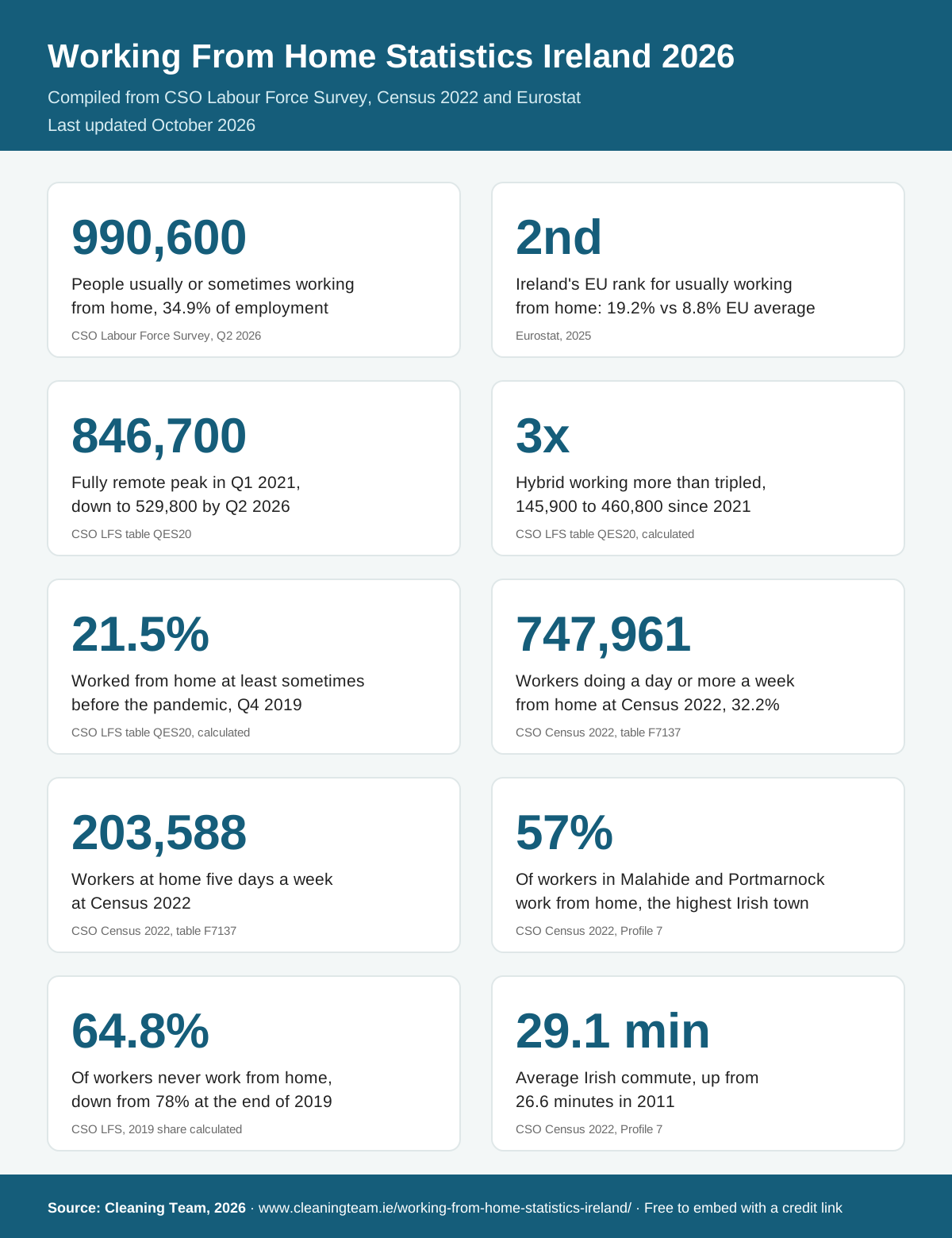
- 990,600 people in Ireland usually or sometimes worked from home in the second quarter of 2026, 34.9% of everyone in employment. Source: CSO Labour Force Survey Q2 2026
- 529,800 of them usually work from home and 460,800 sometimes do, a near-even split between remote and hybrid. Source: CSO LFS table QES20
- Ireland ranks second in the EU for people who usually work from home, at 19.2% of employed 15 to 64 year olds against an EU average of 8.8%. Source: Eurostat, 2025
- Fully remote working peaked at 846,700 people in the first quarter of 2021 and has fallen by 316,900 since, calculated from the CSO series. Source: CSO LFS table QES20
- Over the same period hybrid working rose from 145,900 to 460,800 people, more than tripling, calculated from the same table. Source: CSO LFS table QES20
- Before the pandemic, in the last quarter of 2019, 510,700 people worked from home at least sometimes, 21.5% of those in employment, calculated from the CSO series. Source: CSO LFS table QES20
- Census 2022 counted 747,961 workers doing at least one day a week from home, 32.2% of everyone at work. Source: CSO Census 2022 table F7137
- Of those, 203,588 worked five days a week from home, while 112,109 did a single day. Source: CSO Census 2022 table F7137
- In Malahide and Portmarnock, 57% of workers worked from home at least one day a week, the highest share of any Irish town. Source: CSO Census 2022 Profile 7
- The average Irish commute has lengthened to 29.1 minutes, from 26.6 minutes in 2011, with Meath the longest county at 35 minutes. Source: CSO Census 2022 Profile 7
How Many People Work From Home in Ireland
The CSO's Labour Force Survey is the running count. In the second quarter of 2026, 990,600 people usually or sometimes worked from home, 34.9% of the 2,839,300 people in employment, while 1,839,400 people, 64.8%, never did, according to the CSO Labour Force Survey for Q2 2026, published on 20 August 2026. The home-working total was down 22,500 or 2.2% on a year earlier, and the never-from-home group grew by 43,800, so the drift is real but slow: roughly one worker in a hundred moved back to full-time on-site attendance over the year.
Inside that total, the split matters more than the headline. 529,800 people usually work from home and 460,800 sometimes do, per CSO table QES20. The usually group fell by 25,700 or 4.6% on the second quarter of 2025, while the sometimes group barely moved. Ireland's home working is not disappearing; it is settling into hybrid.
From Remote to Hybrid: the Five Year Swap
The long series tells a cleaner story than any single quarter. In the last quarter of 2019, before the pandemic, 194,600 people usually worked from home and 316,100 sometimes did, a combined 510,700 or 21.5% of the 2,377,800 then in employment, calculated from CSO table QES20. By the first quarter of 2021 the usually group had exploded to 846,700, its all-time peak, while the sometimes group collapsed to 145,900 because there was nowhere else to sometimes be.
What happened next was a swap rather than a retreat. Between that peak and the second quarter of 2026, fully remote working fell by 316,900 people while hybrid working rose by 314,900, calculated from the same table, almost exactly one for one. The combined home-working share has held between a third and 37% since 2022. Put differently, Ireland kept most of its pandemic home-working gain but converted it from five days a week to two or three, and the share of workers who never work from home, 64.8% today, is still well below the 78% recorded at the end of 2019, calculated from the series.
| Quarter | Usually from home | Sometimes from home | Never from home |
|---|---|---|---|
| Q4 2019 | 194,600 | 316,100 | 1,860,900 |
| Q1 2021 (peak) | 846,700 | 145,900 | 1,252,000 |
| Q1 2022 | 719,900 | 248,100 | 1,582,600 |
| Q2 2025 | 555,500 | 457,600 | 1,795,600 |
| Q2 2026 | 529,800 | 460,800 | 1,839,400 |
Source: persons aged 15 and over in employment by extent of working at home, CSO Labour Force Survey table QES20.
Ireland and the EU
Ireland is one of Europe's two home-working outliers. In 2025, 19.2% of employed people aged 15 to 64 in Ireland usually worked from home, second in the EU behind Finland at 20.5% and more than double the EU average of 8.8%, according to Eurostat's harmonised labour force data. Belgium at 13.2% and Germany at 13% trail well behind, and at the far end Bulgaria and Romania record 1.4% and 1.3%. Add the 16.6% of Irish workers who sometimes work from home and Ireland's never-from-home share is 64.2%, against 77% across the union.
The Eurostat series also confirms the direction of travel. Ireland's usually-from-home share has fallen each year from 25.4% in 2022 to 21.4% in 2023, 20.6% in 2024 and 19.2% in 2025, while the sometimes share rose from 11.1% to 16.6% over the same period, the same remote-to-hybrid swap seen in the CSO data, measured on a different basis. Ireland's position near the top of the European table is partly a sector effect, with technology, financial and professional services making up an unusually large share of Irish employment, and partly a legacy of how completely Irish workplaces emptied in 2020 and 2021.
How Many Days: the Census Picture
Census 2022 asked the question differently, by days per week, and gives the most granular national count. Of 2,320,297 people at work in April 2022, 747,961 worked from home at least one day a week, which is 32.2%, calculated from CSO Census 2022 table F7137. The distribution is a flat plateau rather than a peak: 112,109 people worked one day a week from home, 124,238 two days, 119,767 three days, 77,316 four days and 203,588 five days, with a further 7,787 working six and 32,972 working seven days from home. Those on five or more days made up 32.7% of home workers, and those on one or two days 31.6%, calculated from the same table.
Geography sharpens it. Malahide and Portmarnock in Fingal recorded 57% of workers at home at least one day a week, the highest share of any Irish town of 1,500 people or more, and Dublin City saw the largest growth in people working mainly from home since 2016, up by nearly 30,000, according to the CSO Census 2022 Profile 7 key findings. The same release recorded 3.2 million people commuting to work, school or college, 63% of them by car, with an average commute of 29.1 minutes, up from 26.6 minutes in 2011. Men commute longer than women, 31.2 minutes against 26.9, and Meath has the longest county average at 35 minutes.
What It Means for the Home
A million people working from home at least sometimes is a million homes carrying workplace hours on top of household ones. Rooms that once emptied for nine hours a day are occupied, heated and used, which means more wear, more cooking, more dust and more cleaning, landing on top of the 14.5 hours a week Irish adults already spend on housework, a figure sourced on our cleaning and housework statistics page. The division of that extra load is not neutral either: the Irish research on who does the housework, covered on our housework gender gap statistics page, found women doing more than twice men's share before anyone added a home office to the mix. And with people spending up to 90% of winter days indoors, the air quality and damp figures on our mould and damp statistics page describe the environment that a third of the workforce now works in.
What It Means for the Office
For employers, the hybrid plateau has changed the arithmetic of the office itself. With 460,800 people sometimes at home and the typical pattern two or three days a week, offices now run on variable occupancy, full on Tuesdays to Thursdays and quiet on Mondays and Fridays, and cleaning specifications built around five identical days no longer fit. The CSO's never-from-home share of 64.8% also means almost two thirds of Irish workers are on site every day, so hygiene standards covering shared surfaces are as relevant as ever. Our workplace hygiene and injury statistics page carries the absence and injury figures those standards act on, and our guide to office cleaning packages versus in-house staff works through the scheduling question for a hybrid office.
Method and Sources
Every statistic on this page was verified against its named source on 20 October 2026. The sources are the CSO Labour Force Survey Q2 2026 key findings and its table QES20, queried directly from the CSO PxStat API for the full quarterly series from 2019; Eurostat's harmonised labour force dataset lfsa_ehomp, queried from the Eurostat API for 2022 to 2025 and for the 2025 EU ranking; and CSO Census 2022 Profile 7 together with its table F7137 for the day-count and commuting figures. Calculated figures are labelled in the text: the 2019 baseline share, the 316,900 fall and 314,900 rise between the 2021 peak and 2026, the 78% never-from-home share for 2019, the Census shares by days, and the EU multiple. The CSO publishes the Labour Force Survey quarterly, roughly seven weeks after quarter end, and Eurostat updates the annual series each spring; this page will be refreshed on the Q3 2026 release in November and again when the 2026 Eurostat data publishes.
How Cleaning Team Helps
Cleaning Team cleans both ends of the hybrid week: regular house cleaning for homes that now double as workplaces across Dublin, Kildare, Meath and Wicklow, and office cleaning in Dublin scheduled around real occupancy rather than a five-day template. If your home office has quietly become the most used room in the house, or your office is full three days and empty two, contact us for a quote or book online in a few minutes.